El magnate creyó que su camioneta de lujo estaba perdida… hasta que un niño pobre la reparó con solo cuarenta pesos y cambió el destino de los dos para siempre
El empresario multimillonario ya había perdido un vuelo, arruinado una camisa blanca de diseñador que costaba más que la despensa mensual de muchas familias y gritado de frustración contra un teléfono sin señal en medio de un camino de terracería, cuando comprendió que el hombre más poderoso de su mundo se había quedado completamente indefenso.
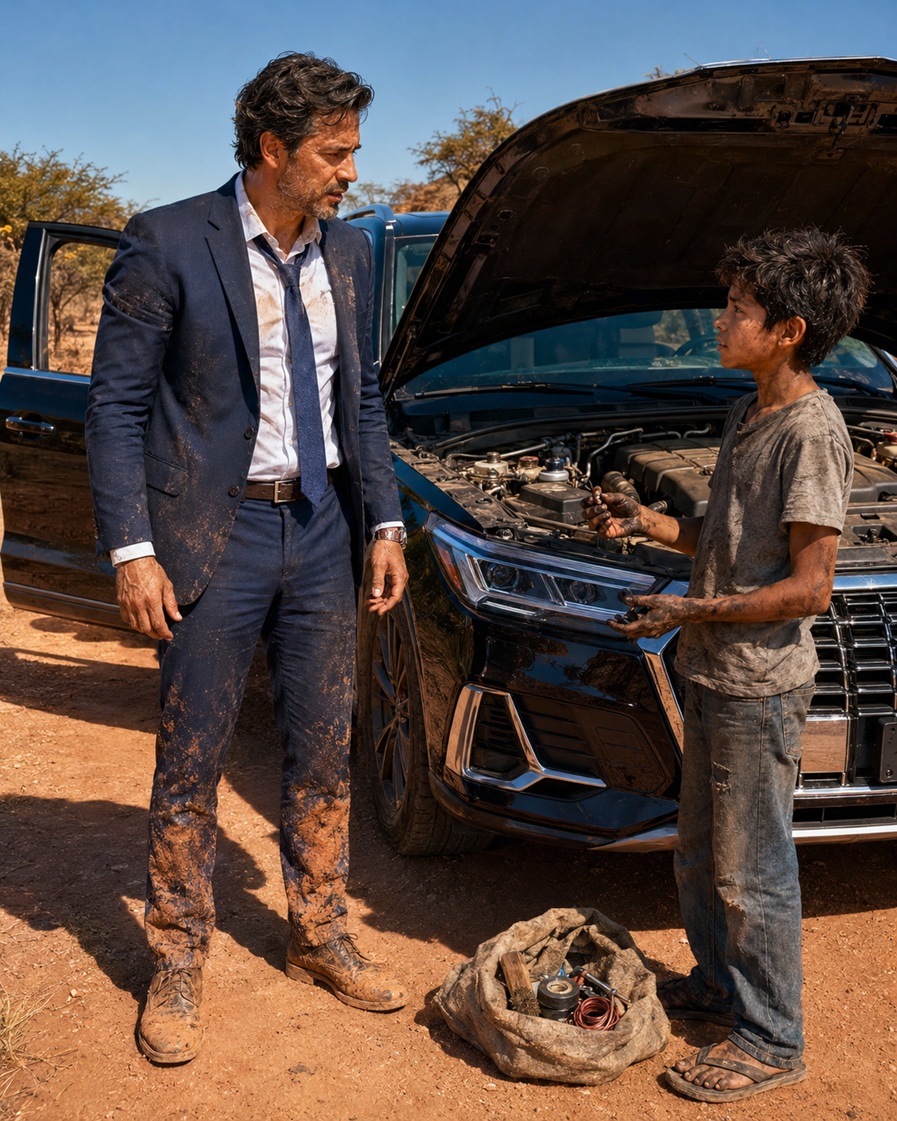
Alejandro Villaseñor permanecía de pie junto a su lujosa camioneta SUV negra, detenida a un costado de un camino polvoriento bajo el sofocante sol de Coahuila, observando el motor con el cofre abierto, como si toda su fortuna pudiera convertirse de pronto en conocimientos de mecánica.
No ocurrió.
El motor permanecía completamente muerto.
El tablero estaba apagado.
El aire acondicionado había dejado de funcionar.
Su celular no tenía señal.
Detrás de él no circulaba ningún vehículo.
Delante tampoco.
Lo único que se movía era una nube de polvo rojizo levantada por el viento seco del desierto.
Alejandro había fundado Villaseñor Energía Renovable, una pequeña empresa en Monterrey, y la había convertido en un imperio valuado en miles de millones de pesos. Tenía oficinas en Ciudad de México, Guadalajara, Monterrey, Madrid y Bogotá. Vivía en un exclusivo penthouse en San Pedro Garza García, poseía una residencia frente al mar en Los Cabos y hasta un chef privado que preparaba su café exactamente como le gustaba.
Pero aquella tarde, cerca del pequeño poblado de El Sauz, en el estado de Coahuila, nada de eso tenía importancia.
Su camioneta estaba completamente averiada.
Su chofer se encontraba a más de tres horas de distancia.
Su asistente ejecutiva no podía comunicarse con él.
Su reloj inteligente seguía recordándole la reunión del consejo directivo que estaba a punto de perder.
Y por primera vez en muchos años, Alejandro Villaseñor no podía resolver un problema haciendo una llamada, firmando un cheque o dando una orden.
—Vamos… enciende… —murmuró mientras presionaba nuevamente el botón de arranque.
Nada.
Ni siquiera un clic.
Retrocedió unos pasos, limpió el sudor de su frente y observó el paisaje.
Matorrales secos.
Mezquites.
Un sol abrasador.
El calor hacía temblar el horizonte como si el aire estuviera ardiendo.
A lo lejos ladró un perro una sola vez y volvió a guardar silencio.
Hasta él parecía agotado.
Alejandro aflojó el nudo de su corbata.
La camisa se le pegaba a la espalda por el sudor.
Sus elegantes zapatos italianos ya estaban cubiertos de polvo rojo.
Por un instante estuvo a punto de reírse de sí mismo.
Había crecido en un barrio humilde de Monterrey.
Antes de los trajes hechos a la medida, las entrevistas en televisión y las reuniones con inversionistas, había sido un niño que compartía un pequeño departamento con su madre, quien muchas veces fingía haber cenado para dejarle el último taco.
Creía recordar perfectamente lo que era pasar calor.
Creía recordar lo que era sentirse impotente.
O al menos eso pensaba.
Entonces escuchó unos pasos.
Lentos.
Pequeños.
Sin prisa.
Un muchacho apareció entre la polvareda, cargando una bolsa reutilizable del mercado.
Era delgado.
Quizá tenía trece o catorce años.
Vestía una camiseta gris desgastada, un pantalón de mezclilla muy usado y unas sandalias de hule ya casi lisas por el desgaste.
Sus manos estaban cubiertas de grasa negra que parecía imposible de quitar.
El muchacho se detuvo a unos seis metros de distancia y miró alternativamente al empresario y al motor abierto.
—Disculpe, señor… ¿se descompuso su camioneta?
Alejandro lo observó durante unos segundos.
Un adolescente.
En medio de la nada.
Con sandalias gastadas.
—Sí —respondió con cautela—. El motor simplemente se apagó. ¿Conoces algún mecánico por aquí?
El muchacho asintió.
—Yo arreglo cosas.
Alejandro estuvo a punto de sonreír.
No porque fuera gracioso.
Sino porque sonaba completamente imposible.
Aquella SUV costaba más que varias de las casas del pueblo por el que acababa de pasar.
Era prácticamente una computadora sobre ruedas.
Sensores.
Software.
Módulos electrónicos.
Muchos mecánicos profesionales evitaban trabajar en ese tipo de vehículos.
Pero el muchacho no sonreía.
Estaba observando atentamente el motor.
No miraba el logotipo de lujo.
Ni los asientos de piel.
Ni el reloj de Alejandro.
Ni su ropa.
Sus ojos recorrían cuidadosamente cada componente del compartimiento del motor con una concentración que hizo que Alejandro dejara de subestimarlo.
—¿Cómo te llamas? —preguntó.
—Emiliano Cruz, señor.
—¿Crees que puedas revisarla?
Emiliano dejó cuidadosamente la bolsa del mercado sobre el suelo.
Después se acercó al vehículo.
No tocó absolutamente nada.
Primero observó.
Sus ojos recorrieron lentamente cada rincón.
Inclinó ligeramente la cabeza.
Escuchó el leve crujido del metal enfriándose.
Siguió con la mirada el recorrido de varios cables.
Alejandro conocía perfectamente esa expresión.
No la había visto en adolescentes.
La había visto en los mejores ingenieros que trabajaban para él.
En esos pocos capaces de comprender un sistema completo con solo observarlo.
—Cuando se apagó… —preguntó Emiliano—, ¿se encendieron todas las luces del tablero al mismo tiempo?
Alejandro abrió los ojos.
—Sí.
—¿Antes sintió como si el motor quisiera seguir funcionando y luego simplemente la computadora lo hubiera apagado?
Alejandro enderezó la espalda.
—Exactamente.
Emiliano asintió con tranquilidad.
—Entonces no creo que el problema sea el motor.
—¿Qué quieres decir?
—Creo que la camioneta cree que el problema es el motor.
—¿Cómo?
—Algún sensor probablemente le está mintiendo a la computadora.
Antes de que Alejandro pudiera responder, Emiliano comenzó a correr hacia unas casas cercanas.
—¿A dónde vas?
—Por mis herramientas. Regreso en dos minutos.
Alejandro lo vio desaparecer detrás de una curva y comenzó a preguntarse si el calor le estaba afectando el juicio.
Estaba confiando una camioneta de millones de pesos a un muchacho que apenas conocía.
Pero no tenía otra alternativa.
Tres minutos después, Emiliano regresó llevando una pequeña bolsa de tela.
La abrió cuidadosamente sobre la defensa del vehículo.
Dentro había un pedazo de cable de cobre.
Una pequeña terminal eléctrica.
Un trozo de lija.
Cinta aislante.
Y un diminuto cepillo metálico.
Todo el contenido probablemente costaba menos de cuarenta pesos.
Emiliano introdujo una mano cerca de la parte trasera del motor.
—Sensor de posición del cigüeñal —explicó—. Es el que le dice a la computadora cuándo debe generar la chispa. Si deja de enviar señal, la camioneta piensa que el motor murió y apaga todo.
Alejandro frunció el ceño.
—¿Dónde aprendiste eso?
—En libros viejos… viendo videos cuando funciona el internet de la biblioteca municipal… y descomponiendo cosas hasta aprender a repararlas.
Emiliano desconectó un pequeño conector y lo mostró.
Los contactos metálicos estaban cubiertos de polvo y corrosión.
—¿Ve esto? El conector no está roto. Solo está muy sucio. Pero la computadora no sabe distinguir entre un contacto sucio y una falla completa.
Limpió cuidadosamente los terminales con el cepillo y la lija.
Después siguió el recorrido del cable.
Se detuvo.
—Aquí está el verdadero problema.
Con la uña señaló una pequeña abertura en el aislamiento.
—El cobre no está cortado… pero está rozando con el metal. Eso provoca un corto y el sensor deja de enviar la señal correctamente.
Trabajó con movimientos rápidos y seguros.
Cortar.
Empalmar.
Aislar.
Asegurar.
Apenas ocho minutos después dio un paso hacia atrás.
—Ahora sí… inténtelo, señor.
Alejandro subió lentamente a la camioneta.
Por alguna razón estaba nervioso.
Presionó el botón de encendido.
El motor rugió de inmediato.
El aire acondicionado volvió a soplar aire frío.
El tablero encendió normalmente.
La música regresó exactamente donde se había detenido.
Alejandro permaneció inmóvil unos segundos.
Luego descendió del vehículo y observó fijamente al muchacho.
—La reparaste…
Emiliano sonrió con humildad.
—Solo era un falso contacto y un cable haciendo corto.
—¿Solo…?
Alejandro stared at Emiliano for several long seconds.
“Just?”
The boy shrugged.
“If you catch it early, yes. If someone keeps trying to start the engine, it can become expensive.”
Alejandro laughed for the first time that day.
Not the polished laugh investors heard during conferences.
A real one.
He reached into his wallet and pulled out every bill he had.
Nearly eight hundred dollars in cash.
He held it toward the teenager.
“You earned this.”
Emiliano didn’t even look at the money.
“I can’t take that.”
Alejandro frowned.
“You just saved me thousands of dollars.”
“My grandfather says you only charge what the job is worth.”
“And what is it worth?”
Emiliano thought seriously.
“Forty pesos.”
Alejandro blinked.
“What?”
“The sandpaper cost twenty. The tape and connector were about twenty more. That’s all.”
“You spent your own supplies.”
“They’ll last for more repairs.”
Alejandro had negotiated billion-dollar acquisitions.
He had convinced governments to approve renewable energy projects.
He had faced television reporters determined to embarrass him.
Yet nothing in his career had prepared him for a fourteen-year-old refusing hundreds of dollars because it wasn’t honest.
“Who taught you that?”
“My grandfather.”
“Where is he?”
“At home.”
“Can I meet him?”
Emiliano hesitated.
“Our house isn’t much.”
“I didn’t ask how big it was.”
The boy smiled.
“No, sir.”
They walked nearly ten minutes down a dusty path until the road disappeared into a cluster of tiny homes built from patched wood, cinder blocks, and corrugated metal.
Children played soccer with a ball held together by tape.
An elderly woman watered tomato plants growing from old paint buckets.
Several neighbors waved at Emiliano.
Everyone seemed to know him.
He waved back to every single person.
“This is home,” he said.
The smallest house sat at the end of the path.
Its roof had been repaired so many times it looked like a patchwork quilt.
A weathered pickup truck without wheels rested beside a pecan tree.
Parts of old lawn mowers, alternators, and bicycle frames were stacked neatly under a tarp.
Not junk.
Inventory.
Inside, an elderly man sat repairing a ceiling fan.
His silver hair was thin.
One leg ended below the knee.
He looked up without surprise.
“You’re late,” he told Emiliano.
“Found someone who needed help.”
The old man smiled.
“I can see that.”
Emiliano introduced them.
“This is my grandfather, Manuel Cruz.”
Alejandro extended his hand.
“Your grandson is extraordinary.”
“I know.”
No pride.
No arrogance.
Only certainty.
“He learned because he wanted to.”
Alejandro noticed shelves filled with library books.
Electrical manuals.
Physics textbooks.
Automotive engineering guides.
Many were decades old.
Some were missing covers.
Every page had notes written carefully in the margins.
“You’ve read all these?” Alejandro asked.
Emiliano nodded.
“Some twice.”
“Why aren’t you in school?”
Silence filled the room.
Finally Manuel answered.
“He was.”
“What happened?”
“The bus route was canceled two years ago.”
Alejandro looked confused.
“The nearest high school is twenty-eight miles away.”
“No transportation?”
“No transportation.”
“No online classes?”
“We don’t have reliable internet.”
Alejandro looked around again.
The entire room contained less wealth than the watch on his wrist.
Yet it contained more books than many executive offices.
“What do you want to become?” he asked Emiliano.
The boy answered immediately.
“An engineer.”
“What kind?”
“The kind that fixes problems before people notice them.”
Alejandro slowly sat down.
That answer stayed with him.
Not because it was clever.
Because he believed it.
Before leaving, Alejandro placed his business card on the table.
“If you ever need anything…”
Manuel gently pushed it back.
“If you truly want to repay him, don’t give him charity.”
“What should I give him?”
“A chance.”
…
Three weeks later, black SUVs rolled into El Sauz.
The entire town gathered outside.
Some believed a politician had arrived.
Others thought it was the tax office.
Instead, Alejandro stepped out wearing jeans instead of a suit.
Behind him came engineers, surveyors, electricians, and architects.
A temporary stage was assembled beside the abandoned community center.
Alejandro took the microphone.
“Three weeks ago my vehicle broke down on your road.”
People laughed softly.
“A young man repaired it with supplies worth forty pesos.”
He looked toward Emiliano.
“That repair saved me more than a meeting.”
“It reminded me who I used to be.”
He announced that Hayes’ Mexican division would fund the restoration of the community center.
A computer laboratory.
High-speed satellite internet.
A mechanical workshop.
Scholarships.
A transportation program taking students to high school every day.
The crowd applauded.
Then Alejandro surprised everyone again.
“This is not a donation.”
The applause stopped.
“This is an investment.”
He turned toward Emiliano.
“In talent.”
…
Six months later, Emiliano became the first student from El Sauz to receive a full engineering scholarship sponsored by Villaseñor Energía Renovable.
Television crews arrived.
Reporters asked predictable questions.
“How does it feel to escape poverty?”
Emiliano smiled politely.
“I never wanted to escape my town.”
“I just wanted opportunities to return with more knowledge.”
That answer spread across social media.
Millions watched the interview.
People called him “the mechanic genius.”
He disliked the nickname.
“I’ve still got a lot to learn,” he always answered.
…
Four years passed.
Alejandro often visited quietly.
Never with cameras.
Sometimes he and Manuel repaired old radios together.
Sometimes they simply drank coffee beneath the pecan tree.
Manuel never allowed anyone to treat him differently because a billionaire visited.
“You’re still Alejandro.”
“Yes, sir.”
“And you still make mistakes.”
“Yes, sir.”
“Good.”
…
Near Emiliano’s graduation from university, Alejandro invited him to headquarters in Monterrey.
The boardroom overlooked the entire city.
Executives whispered as the young engineer entered.
Some recognized him from the famous story.
Others simply saw another scholarship student.
Alejandro stood.
“I have an announcement.”
The directors expected another acquisition.
Instead, he displayed two photographs.
The first showed his broken SUV on the dusty road.
The second showed a fourteen-year-old boy holding a dirty electrical connector.
“This,” Alejandro said, “was the most profitable investment this company has ever made.”
Confused expressions filled the room.
He continued.
“Not because he repaired a vehicle.”
“Because he reminded me that talent doesn’t ask where it’s born.”
He offered Emiliano a senior engineering position before graduation.
The salary alone exceeded anything the Cruz family had imagined.
Emiliano listened quietly.
Then he asked a question.
“May I decline?”
The room froze.
Alejandro smiled.
“You certainly may.”
“I want to build something first.”
“What?”
“A training center.”
“Here?”
“In El Sauz.”
“For children who think they’re too poor to become engineers.”
Alejandro’s eyes became moist.
“What do you need?”
Emiliano reached into his backpack.
He placed an old cloth tool pouch on the conference table.
The same pouch.
The same sandpaper.
The same tiny brush.
The same roll of tape.
“I already have my first toolbox.”
Everyone laughed softly.
Then Alejandro asked again.
“What else?”
Emiliano answered.
“A partner.”
…
Two years later, the Cruz Innovation Center opened.
Not in Monterrey.
Not in Mexico City.
In El Sauz.
Students arrived from villages across northern Mexico.
Every tool was free.
Every textbook belonged to everyone.
The entrance displayed a simple plaque.
It did not mention billions.
It did not mention awards.
It simply read:
“Knowledge grows when it is shared.”
On opening day, Manuel cut the ribbon.
His hands trembled with age.
His eyes overflowed with tears.
“I thought my grandson fixed a broken truck,” he whispered.
Alejandro gently shook his head.
“No.”
“He repaired something much more expensive.”
“What?”
“My way of seeing the world.”
…
Years later, during an international technology conference, a journalist asked Alejandro the question he had answered hundreds of times.
“What was the smartest business decision of your career?”
People expected him to mention a merger.
A patent.
A billion-dollar investment.
Instead he smiled.
“Getting stranded on a dirt road.”
The audience laughed.
He continued.
“I thought a poor boy repaired my SUV.”
“He actually repaired a broken belief.”
“I used to think opportunity created talent.”
He paused.
“That day I learned the truth.”
“Talent already exists.”
“Opportunity simply decides whether the world ever gets to see it.”
The room stood in applause.
In the front row, Emiliano looked toward his grandfather.
Manuel smiled proudly.
The old mechanic had never become wealthy.
He never owned a mansion.
He never traveled the world.
Yet in that moment, Alejandro realized something astonishing.
Among everyone in the auditorium…
The richest man had never been the billionaire.
It had always been the grandfather who had taught a little boy that honesty was worth more than money, knowledge was worth more than comfort, and that the greatest repair a person could ever make was not to an engine—
—but to another human being’s future.
Disclaimer : This content may be created by AI for entertainment purposes. Any resemblance to real persons, events, or places is coincidental.
